
Chris Conner & Franchise Marketing Systems (FMS Franchise)
January 9, 2026
Derby City Pizza Franchise System Launch
January 22, 2026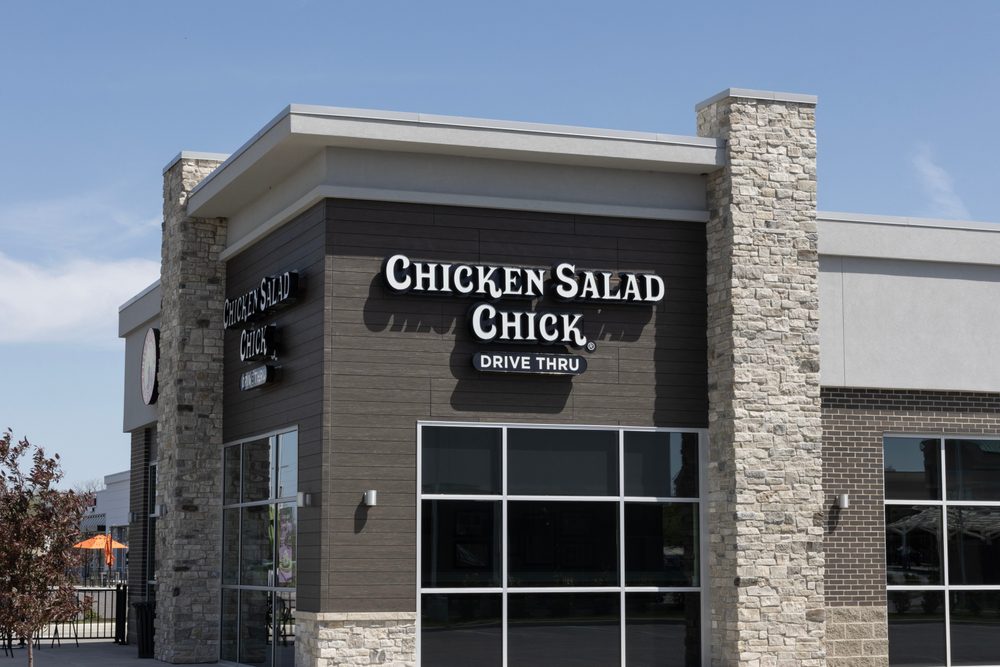

Chicken Salad Chick is one of the clearest examples in modern fast casual of a brand taking a simple, highly focused product category—fresh chicken salad—then scaling it into a multi-state franchise system through operational consistency, approachable unit economics, and a strong “Southern hospitality” brand personality. Founded in Auburn, Alabama in 2008 by Stacy and Kevin Brown, the concept grew from humble beginnings into a national franchise brand with 300+ locations and continued development momentum.
This overview covers how the brand began, the strategic decisions that made it franchiseable, and the key milestones that accelerated its growth through franchising.
1) The Start: A Simple Product, Done Remarkably Well
Chicken Salad Chick’s origin story is closely tied to its product focus. According to the company’s own “About” page, Chicken Salad Chick was founded in 2008 in Auburn, Alabama by Stacy and Kevin Brown, built around the idea of fresh, made-from-scratch chicken salad served with warm hospitality.
That starting point matters because the concept didn’t begin as a broad menu restaurant. Instead, it started with a clear identity: specialize deeply, execute consistently, and build a community-friendly experience around the core offering.
Over time, the menu evolved beyond chicken salad scoops to include complementary items—sandwiches, sides, soups, and desserts—while still keeping chicken salad as the centerpiece. This tight menu focus is one of the “quiet advantages” that helped the concept become franchise-ready: fewer operational variables, more consistent training, and more repeatable execution across markets.
2) Why the Concept Was Naturally Franchiseable
Not every restaurant concept franchises well. Chicken Salad Chick had several characteristics that supported franchising early:
A) A differentiated niche in fast casual
Chicken Salad Chick positions itself as the nation’s only fast-casual restaurant concept dedicated exclusively to chicken salad, which helps it stand out in a crowded category.
Whether or not a consumer agrees with “only,” the strategic idea is strong: the brand occupies a niche that is easy to explain and easy to remember—an important factor in franchise marketing.
B) Operational simplicity (relative to many restaurant models)
Compared to concepts that rely on fryers, grills, complex cook lines, or heavy late-night traffic, Chicken Salad Chick can operate with a production rhythm that is often more predictable. Simpler operations make it easier to:
-
train new franchisees and managers
-
maintain quality control
-
run with consistent labor models
-
replicate the experience in multiple markets
C) Broad demographic appeal
Chicken Salad Chick has built a customer base around daytime and early evening traffic and a “comfort food + freshness” positioning. That tends to support multi-occasion usage: lunch, takeout, catering, and family meals—helpful drivers for franchisee unit economics.
Learn more about what makes a business model franchiseable and how to franchise:
https://www.franchiseindustryblog.com/how-to-franchise/
3) The Growth Engine: Franchising as a Strategic Scale Model
Chicken Salad Chick is not just a restaurant chain—it is explicitly a franchise system, built to grow through franchised operators.
The brand’s growth arc reflects a pattern common to successful fast-casual franchising:
-
prove the concept locally
-
refine systems and brand standards
-
expand into nearby markets
- scale through franchise partners and multi-unit operators
Over time, the brand expanded into multiple states, building a larger footprint and improving brand awareness in the Southeast and beyond.
By 2025, multiple sources reported Chicken Salad Chick had reached (and celebrated) its 300th location milestone, with additional signed franchise agreements fueling future openings.
That 300-location milestone is meaningful—not just as a number, but because it signals a system that has matured past early-stage franchising and into a more established platform capable of consistent multi-market development.
Understand the franchise model in more detail with Chris Conner from Franchise Marketing Systems: https://www.youtube.com/watch?v=SWM3XFxTNcs&t=786s&pp=ygUXQ29ubmVyIGhvdyB0byBmcmFuY2hpc2U%3D
4) Ownership and Investment Milestones that Accelerated Scale
Like many high-growth franchise brands, Chicken Salad Chick’s expansion has been supported by institutional investment and ownership transitions that provided capital, infrastructure, and strategic support.
A) Eagle Merchant Partners (majority stake)
A key turning point highlighted in franchise and business coverage is the period when private equity became involved. QSR Magazine reported that Eagle Merchant Partners purchased a majority stake (mid-2010s) and helped accelerate growth, adding more than 100 new locations during that ownership period.
B) Acquisition by Brentwood Associates (2019)
In 2019, private equity firm Brentwood Associates acquired a majority interest in Chicken Salad Chick from Eagle Merchant Partners. Brentwood’s press release described the brand at the time as having 137 locations across 16 states, predominantly in the Southeast.
Restaurant Dive’s coverage of the deal noted that the brand’s system sales increased significantly during Eagle Merchant Partners’ ownership and emphasized Brentwood’s role as a consumer-focused investor with restaurant experience.
Why this matters for franchising: private equity involvement often correlates with investments in:
-
franchisee support infrastructure
-
marketing and brand development
-
technology systems (CRM, online ordering, loyalty)
-
real estate development playbooks
-
stronger multi-unit franchise recruitment
These investments can dramatically improve a franchisor’s ability to scale responsibly.
5) What Growth Looks Like Today: Footprint, Momentum, and Development Focus
Chicken Salad Chick’s current scale is often reported as 300+ locations. The brand itself promotes “over 300 locations and counting” on its franchising page.
Industry coverage in 2025 also reinforced this growth—QSR reported the brand hit its 300th location and continued opening stores and signing new franchise agreements that year.
The International Franchise Association (IFA) highlighted the brand’s franchise momentum and referenced its strong recognition across franchise rankings and awards, reflecting industry visibility as the brand expands.
A practical takeaway: when a franchise brand reaches 300 units, it has typically developed:
-
repeatable site selection criteria
-
stronger onboarding and training programs
-
improved marketing systems
-
deeper operator benchmarks and KPIs
-
and more validated unit performance patterns
That doesn’t mean every unit is perfect—but it usually indicates that the franchisor has moved well beyond the “experimental” stage.
6) The Brand’s “Franchise Story”: Why Franchisees Say Yes
From a franchise recruitment standpoint, Chicken Salad Chick’s appeal tends to come from a combination of product differentiation and operational approach.
A) A concept that’s easy to communicate
Franchise prospects and consumers both understand the pitch quickly: chicken salad, made fresh, served in many flavors, in a welcoming fast-casual format.
B) A menu that supports repeat visits
A signature element is offering multiple chicken salad flavors (often marketed as a variety lineup). That variety supports repeat frequency—customers can “rotate” favorites and try new flavors, which helps same-store sales over time.
C) A daytime-friendly operating pattern
Many successful franchise systems build around strong lunch and early dinner dayparts, plus takeout and catering. The Chicken Salad Chick model supports those occasions and often fits markets that value quick, fresh meals.
7) Franchising Strategy: Market Expansion and Multi-Unit Development
As a franchise system scales, growth increasingly comes from:
-
multi-unit franchise groups
-
experienced restaurant operators
-
and strategic development in targeted regions
In 2025, reported development focus included expansion into several Midwestern and Northeast-adjacent states (a sign of continued geographic diversification beyond the Southeast).
You can also see multi-unit franchise activity in news releases and business coverage—franchise groups acquiring and operating multiple units, which often indicates that existing operators see enough economic potential to scale within the system.
8) The Operational Backbone: Systems, Training, and Consistency
The strongest franchise brands win because they build a system that franchisees can execute—not because they have a clever menu.
While the specifics of Chicken Salad Chick’s internal training and support systems are detailed most precisely in its franchise disclosure documentation and franchise materials, the public-facing franchising narrative emphasizes:
-
a “proven” model
-
community positioning
-
brand consistency
-
and the ability to bring the concept to new communities
This aligns with the broader pattern of successful restaurant franchisors: they create a repeatable launch process, operational playbooks, and ongoing franchisee support infrastructure.
Learn more about some of the key business decisions that impact your business’ ability to scale through franchising: https://www.strategicfranchisebrokers.com/key-business-decisions-that-impact-your-long-term-success-in-franchising/
9) A Milestone Moment: The 300th Store and Continued Expansion
Hitting the 300th store milestone is one of the clearest markers of Chicken Salad Chick’s successful franchise growth. In 2025 coverage, the brand reported a strong start to the year that included opening new restaurants and signing additional franchise agreements for future development.
That combination—new openings plus new agreements—is important. Openings show execution; agreements show pipeline.
For prospective franchisees and industry watchers, it signals:
-
the brand continues to attract operators
-
the franchisor is still investing in growth
-
and expansion is not solely dependent on corporate-owned stores
10) What Chicken Salad Chick’s Growth Teaches Emerging Franchisors
Chicken Salad Chick is a valuable case study for early-stage franchisors because it demonstrates several repeatable lessons:
Lesson 1: Win with focus
Rather than trying to be a broad “everything” restaurant, it scaled with a focused flagship product and a consistent brand message.
Lesson 2: Build franchiseability through systems
A franchise system grows when the model is teachable, repeatable, and operationally consistent across markets.
Lesson 3: Capital and infrastructure accelerate expansion
Private equity investment and ownership transitions helped provide scale resources at key points—especially as the system moved from regional growth to national momentum.
Lesson 4: Milestones matter
The 300-location milestone is not just PR—it signals maturity in franchise systems, development capability, and market reach.
A Focused Fast-Casual Concept That Scaled into a National Franchise Brand
Chicken Salad Chick’s journey—from its founding in Auburn, Alabama in 2008 to a brand with 300+ locations—shows how a focused menu, clear brand identity, and a scalable franchise system can create sustained growth in the restaurant franchise space.
The brand’s franchise growth has been supported by strategic expansion, increasing franchisee demand, and institutional ownership transitions—such as the 2019 acquisition by Brentwood Associates—helping to build the infrastructure required for multi-state scale.
For franchise buyers, Chicken Salad Chick represents a concept that has moved beyond early-stage uncertainty into a more established franchise platform. For franchisors, it’s a strong example of what happens when product focus meets operational discipline—and when franchising is treated as a long-term system-building exercise rather than a short-term sales strategy.
For more information on how to franchise your restaurant business, contact Franchise Marketing Systems: www.FMSFranchise.com