
The Home Guys Real Estate Franchise System Launch
December 22, 2025
Comparison of Franchised Burger Brands Unit Sales Volume
January 9, 2026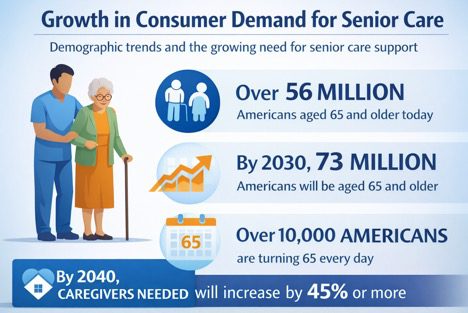

Why the category keeps growing
In-home care demand is being driven by aging demographics and the “age in place” preference—more seniors want support at home rather than moving into facilities. Industry research firms project continued growth in U.S. home healthcare services (broadly defined) through the next decade. These trends for growth in the senior care aren’t going anywhere either. More and more, the demand and need for our aging population is growing at a exceedingly rapid pace and there just aren’t enough service providers out there to manage the tidal wave of growing demand.
Market structure for Senior Care Services
The competitive landscape is highly fragmented. Even in industry analyses of U.S. home care providers, no single company holds a dominant share (i.e., it’s not a winner-take-all market), which is why franchises can still enter new territories and win locally with strong execution.
What “wins” competitively (the real differentiators)
In-home care franchises compete on a few consistent levers:
-
Caregiver recruiting + retention engine
The biggest constraint is labor. Brands with better recruiting funnels, training, scheduling tools, and retention practices tend to outperform. -
Referral networks and local market development
Hospitals, discharge planners, rehab facilities, senior living communities, and geriatric care managers can be major referral sources. The strongest systems teach franchisees how to build those relationships. -
Service mix and payer mix
Most franchise brands focus on private-pay non-medical care (companionship, personal care), while some add skilled care, staffing, or nurse-led models for broader revenue streams. -
Operations + compliance infrastructure
State-level licensing requirements, documentation, supervision, and quality controls can vary. Brands with mature compliance and training systems reduce owner risk. -
Brand strength + consumer trust
Trust matters heavily in caregiver services. National recognition helps, but local reviews and community credibility are often what converts.
Competitive intensity
Industry rankings show multiple large players with meaningful scale (systemwide sales and unit counts), and a second tier of strong mid-sized brands. For example, several home-based care franchises ranked highly on Franchise Times’ Top 400 and Entrepreneur’s Franchise 500 lists, reflecting both scale and ongoing franchise expansion momentum.
Short review of top in-home care franchise brands
1) Home Instead
Positioning: Category leader; widely recognized senior in-home care brand
Competitive edge: Strong brand awareness and long-standing referral relationships; often the “default” name consumers recognize in many markets.
Best fit franchisee: Operators who want a mature system and can execute in competitive territories.
Watch-outs: Brand strength can come with structured requirements and competition in mature metro areas. (Recognized among top systems in Franchise Times rankings.)
2) Visiting Angels
Positioning: Large private-duty non-medical senior care franchise
Competitive edge: Strong local-market model with emphasis on relationship building and community presence; large national footprint and consumer familiarity. (Also listed among top systems in Franchise Times rankings.)
Best fit franchisee: Relationship-driven owners who excel at local networking and caregiver recruiting.
Watch-outs: Like most non-medical care models, performance hinges on labor supply and scheduling efficiency.
3) Right at Home
Positioning: Broad in-home care for seniors and adults with disabilities; strong franchise development
Competitive edge: Consistent recognition in major franchise rankings and an established development engine (the brand highlights multi-year placement in Entrepreneur’s Franchise 500).
Best fit franchisee: Operators looking for a large system with an established playbook for growth.
Watch-outs: Competitive markets require strong differentiation through service quality and caregiver stability.
4) Comfort Keepers
Positioning: Non-medical home care with a “interactive caregiving” style brand narrative
Competitive edge: Another scaled player frequently cited among top-performing home-based care franchise systems by industry coverage.
Best fit franchisee: Community-oriented operators comfortable building local referral pipelines.
Watch-outs: Differentiation is often experiential (care quality, consistency), not product-based.
5) BrightStar Care
Positioning: Higher-acuity model offering both non-medical and skilled services (depending on market/regulatory structure), often positioned as “premium clinical quality”
Competitive edge: Brand messaging emphasizes Joint Commission accreditation and nurse-led oversight as a differentiator in quality perception.
Best fit franchisee: Operators seeking a more clinically positioned model and willing to manage a more complex compliance/staffing structure.
Watch-outs: Typically more operationally intensive than pure companion/personal care models.
6) Senior Helpers
Positioning: Senior-focused in-home care with strong dementia/Alzheimer’s-related positioning in many markets
Competitive edge: Recognized in Entrepreneur’s Franchise 500 home-based care coverage (indicative of ongoing franchise scale and visibility).
Best fit franchisee: Owners who want a senior-first brand with strong training emphasis and local outreach.
Watch-outs: Similar labor and referral challenges as peers; differentiation depends on program execution.
7) FirstLight Home Care
Positioning: Non-medical home care with premium “culture of care” branding
Competitive edge: Also appears in Entrepreneur’s Franchise 500 home-based care coverage, suggesting continued franchise growth and competitive positioning.
Best fit franchisee: Operators who want a relationship-driven brand with strong local business development.
Watch-outs: Premium positioning must be supported by caregiver quality and consistency.
8) SYNERGY HomeCare
Positioning: Broad non-medical home care with flexible service offerings
Competitive edge: Often competes on operational flexibility and broad service categories, appealing to diverse client needs. (Frequently cited alongside top tier brands in market comparisons and competitive discussions.)
Best fit franchisee: Owners who want flexibility in service mix and a scalable local model.
Watch-outs: Success depends on local execution more than national brand pull.
Quick “who wins where” summary
-
Best brand power / household recognition: Home Instead, Visiting Angels
-
Best premium clinical-quality angle: BrightStar Care
-
Best “franchise momentum” visibility (rankings presence): Right at Home, Senior Helpers, FirstLight
-
Most common success driver across all brands: caregiver recruiting + retention + local referral engine (execution > concept)
Bottom line
The in-home caregiver franchise market remains attractive because demand is expanding and the industry is still fragmented, leaving room for strong operators to win territory-by-territory. The “best” brand typically comes down to fit: how much brand recognition you want vs. how complex a clinical model you’re willing to run, and how strong your local recruiting and referral-building capabilities are.
For more information on how to franchise your senior care business, contact Franchise Marketing Systems: www.FMSFranchise.com
or
For more information on how to find the right senior care franchise opportunity, connect with Franchise Funding Solutions: www.FranchiseFundingSolutions.com